Tuesday, April 14, 2015

Race Report

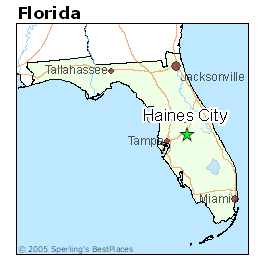
Haines City Half Iron Man 70.3  April 12, 2015


 Image result for haines city images
Preparing for an early season half takes a lot of planning when you live in Chicago.  I’ve spent a good part of the fall and early spring riding my bike on  computrainer rides, mostly on Thursday mornings doing strength training.  I’ve done a few longer rides  on the weekends but I think I should have done more.  I also didn’t have the time to do many long runs, the longest run was about 7 miles outside on a warm day in Chicago about 2 weeks before the race.  I was doing a lot of track running for speed and had improved my time from 13 min pace down to 10:30 min pace over the last six months but I was probably needing more longer runs combined with bike rides.  My swim was certainly improving in the pool and I had had some opportunities for open water swims when I was in Florida and Puerto Rico, but not long enough to really call them good training. 

So prepared as I was, I had hoped to be able to PR for Haines City, expecting a rather flat course and in early April, cooler temperatures.  However, that was not the case.  Haines City is certainly not a flat bike ride.  Long rolling hills and some intense climbs combined with some long downward rides. 
But let me begin with the beginning, the day before the race.  I did get my bike out the week of the race and do a 12 mile ride on Zip with new lubrication and inner tubes, made necessary by forgetting to deflate my tires before shipping the bike in my new Eshipper on the plane.  I bought my inner tubes at the Bike ship in Winter Haven and they did a nice job.  I also replenished my CO2 for the race.  They have a well-equipped shop and pretty nice people there. 
I also managed a short run around the complex, Orange Manor to get my legs going and to get used to the heat.  Right away it was hot and humid that week.  Close to 90 degrees all week and 80% humidity.  That meant the water was warm.  The Lake Eva Park where the race is held is shown below: 
Image result for lake eva images

The day before the race I set out early to drive the course.   I found much of it but did not get to the hilliest part, Poinciana which had me fooled and expecting a fairly easy ride.  Don’t get me wrong I’m not lazy, but I wanted a course for training for the distance rather than for strength.  I got the latter, not the former. 
So I arrived at the HI expo for registration, got my silicone swim cap (they actually had them for racers allergic to latex..that was a first!) and listened to the course talk.  They described the swim format as a big M.  The athlete guide also laid out the swim course as a big M.  I swam the first leg of the M and was turned back before the first turn buoy by the lifeguards who said they didn’t have enough coverage that day to allow us to swim the whole leg.  That meant I did not get to scope out the format of the course and that would prove to be an issue on race day. 
I then spent a good part of the day with Matt, CEO of Base Performance, as an ambassador and helped him sell Base Salt all day.  We made a good team and recorded some good testimonies of racers who stated he had saved their race at various locations last year.  It was a productive day for Base Performance. 

I got into a conversation with another ambassador, Mike, who was a certified bike trainer as well and he gave me some advice on training to improve my biking as well as discussed the possibility that I might need a new chain.  I took my bike over to Epic Bikes and they put a new chain on in about two hours that day.  I think that was one of the best decisions I made for this race.  Thanks to Mike for his advice!  I hope he did well.  I then checked my bike into transition checked out the layout and left for home, about 25 mins away in Winter Haven with my parents at their summer home.
On race day I arrived, sans Sherpa help, set up my transition and was ready to rock.  The water temperature did not cool down overnight despite the torrential downpour the night before.  My bike was pretty soaked but my seat doesn’t absorb much and the bike was unscathed.  I wiped it down and set up everything.  My transition is pretty simple.  I don’t wear socks.  I have bike shoes and put spray sunscreen into one shoe and glucose into the other.  ( I buy glucose in purest form from the diabetic supplies in the pharmacy. I’ll discuss why later.).  I put my helmet on the handlebars with the strap hooked on the hoods with my sunglasses inside.  My running shoes are next with race belt and bib, water bottle belt with nutrition on top with my hat on top of that.  I also leave an extra bottle of water to wash off my feet and a towel.  That’s it.
 Image result for images of haines city ironman athletes
Swim start at the race


I put a gu packet in my tri kit for the swim, carry my cap and goggles.  I save the space blankets when I get them and use them to keep warm on race mornings. I then toss them as I go through the arch to the swim start.  I was glad I had it that morning.  It was a bit chilly.  I hate sacrificing clothes so the space blanket is a nice thing to have. 
So race morning, they announced that the swim was not wetsuit legal.  That is fine with me.  I don’t like wetsuits and the one I had is untried.  I bought it last year and still have not been able to use it outdoors to test it.  I wasn’t looking forward to using something new on race day.  It’s still in the wrapper and in the hold of the plane with my bike box as I fly home.  I’ll get a chance to try it out later this season I’m sure when we start swimming in Lake Michigan in July. 
So with the playing field pretty level for the swim I was more confident of a good swim than normal.  However the unfamiliarity with the way the course was actually laid out was to undermine my hopes for a quicker swim.  I got to the first turn buoy expecting only three.  Instead there were more like six!  That was confusing when I turned around the first turn buoy only to find that I was swimming the wrong direction and instead of a 135 degree angle was were doing a 90 degree angle, then another 90 degree and swimming a long leg back down, another 90 degree left and then another left and a long leg back up the lake and two more turns right and back down the lake to the finish.  I spent some time at the first set of turns trying to figure out what was going on without losing too much time.  I must have done okay because I ended up with a 46 min swim, better than I would have guessed with all the sighting I ended up doing plus the stops I had to make to figure out what the heck was going on.  I had hopes for a 35 min swim so I think I lost a lot time with all that plus momentum losses.  I must’ve swum pretty fast when I was swimming though because I still ended up with 2 min/100 yd swim average for the course. 

I managed a jog up to transition ( I had to remind myself to hit my lap button the garmin, which was new to me as well and  forgot to do that as I exited for the bike leg.)  I wasn’t the last person into transition for the bike and I wasn’t the first either but I expected that.  I felt pretty good about how I had done on that part.  I got my sunscreen on, helmet and sunglasses but had to struggle to get my shoes on.  I had remembered to run through the kiddie pool to wash off my feet so they were pretty sand free when I reached transition.  I washed them again and dried them figuring I’d be happier with myself if I didn’t end up with blisters on the run. I also sucked down some liquid glucose, grape flavor, as I got ready.   They had transition set up so that you had to run around the whole area to make it fair, so I got myself going with the bike and headed to the exit.  I had my gears set right so I hopped on the bike and was happy to see my bike computer registering speed correctly.  I had had to play with it quite a bit the day before to get it reading speed.  I replaced the batteries but one of the leads had gotten bent on the wheel sensor and it wasn’t connecting and transmitting.  That took about an hour to figure out and adjust.  So feeling like I was doing well, I headed out.  I had forgotten to open my gu packet after the swim and suck some of it down so I opened my lemonade Huma Packet early on.  I had to dig around in my bento box for my Base Salt container.  Lesson learned, put it standing up close to the end so I can find it.  I also finally remembered to hit the lap button on the Garmin to indicate I’d started the bike leg, about 2 miles in.
I felt great on the first 20 miles.  I had my salt I was booking along at 16+ mph, in some cases hitting 22 mph, but so was everyone else.  I don’t expect to lead the pack on the bike and at about 20 miles the younger men and women started to pass me.  I ran into some trouble keeping my speed up from 20-35 with some hills that slowed me to 12 mph, but I was not worried, knowing I was adding 24-28 mph to the average as I went down those same hills.  This bike ride is a single loop so you don’t see any part of it more than once.  That’s both nice and not nice as you don’t know what’s coming at any point.  At mile 35 aid station, I took some Gatorade, feeling the effects of the humidity.  I open my water bottles on the way to the aid station and put the lid under the leg of my shorts to hold it.  Unfortunately I had also stowed my salt there and forgot about that.  I grabbed the Gatorade and poured it into the water bottle in front; my protocol is to keep any mixture in the front bottle and pure water in the back bottle.  I grabbed the lid from my shorts and when I did the salt container slipped out.  I had to make a decision whether to stop and pick it up or go on and decided to go on and use Gatorade for the remainder of the race.  That was a fateful decision I think.  I could have used that salt and it would get me later in the race. 
Image result for images of haines city ironman athletes biking
The rest of the ride was very hilly.  The inclines were not terrible like Las Vegas or Honu, but in some ways long slow inclines are more wearing.  When you have short steep hill, you can put out a short burst of effort to get up that hill, maybe at 6 or 8 mph but it’s over in short order.  When you have a long slow climb you end up slowing more and more, shifting gears and working hard to determine where you want to end up at the top in gearing and effort.  There were at least two hills where I was at 9 mph by the end and a couple more where I ended up at 12 mph.  I was disappointed about that as I had wanted to get up to 17+ mph average and could see my average sliding with each successive hill.  I tried to keep a positive attitude but as I labored on those hills, my right foot began to ache.
I have high arches. And apparently I have a very dominant right leg.  After the race I looked at both quads and I could see that my left leg is not as strong or as muscular as my right.  Thus when I’m really working, I tend to use my right leg a lot more.  This pulls on the tendon of my right foot and that tendon, working so hard, begins to hurt.  I tried to focus on pulling up and using both legs but fatigue makes your form fall apart, and without salt and the foot pain, my form began to weaken.  I slowed a bit.  I tried stretching my foot by standing and flexing my foot but I had pushed that leg hard all day by mile 45.  I like to see mile 40 because I know I can do 16 miles easily so once I was there I felt I had made it.  I got through the end of the race ignoring the foot pain but when I dismounted, I nearly fell due to the pain in my right foot.  That was not a good sign. 
Image result for images of haines city ironman athletes

I made it to transition but had to walk.  I felt the pain in my right foot acutely but switched in to running mode anyway.  I walked out of transition with considerable pain with every step.  My heel and the outside of my right foot hurt with every motion.  I was in trouble and I knew it.  I took some salt and hunted in my running nutrition for some biofreeze but I had not put any in there.  I also had no aspirin.  Now I know I’m not supposed to take NSAIDS on a race but I’ve done it in a marathon to get from mile 17 to the end with no ill effects so I would have taken some if I had it.  But no luck that day.  I think I was mildly low on electrolytes and in pain for the run start so I began with a deficit that would worsen as the run progressed.  I tried to take in more nutrition and salt in small doses but it would be almost the end of the long slog before I felt I had recovered what I had lost. 
Image result for images of haines city ironman athletes

I walked slowed to mile 1 and aid station 1 and stopped.  It had taken me 20 minutes to get there.  I asked for medic help but they said if I took any medication I would DSQ.  I knew I did not want that on my record but I needed some help.  They said they could give me a bag of ice and some gauze wrap.  I sat and iced my foot for 5-10 minutes and took the gauze but never used it.  My foot felt better and I managed to move forward but each attempt to run ended up aggravating the foot and later my legs would seize up.  I was forced to walk nearly the whole 13.1 miles and I was thoroughly disgusted with myself.  I had screwed up and wasn’t as prepared as I had hoped.  I was not dead last on that course that day and many many racers were walking.  It was very hot.  I was on the run from 11:30 to 3:30 PM, the hottest part of the day.  No cloud cover and no breeze on much of the course and of course high humidity from the previous night’s rains made for a very miserable trudge.  I talked to several other racers and met a few folks on the course so it was fun to hear other’s stories and meet new people, but I would have preferred to hit my running stride and gotten to the finish about an hour earlier than I did, which is what I had planned. 
Rather than a PR day, it was one of my slower races and a disappointing performance but then again it was the first race of the season and a good test of my fitness level and my preparation.  I finished in 7:56, just under 8 hours but an hour before the last racer arrived so I was happy to not be last.  I came in 20th in my age group which also made me happy.  I think there were 30+ in my age group.  I haven’t gone back to check but I will. 

I managed to run across the finish line and as I did my parents yelled out to me and waved.  That, I think, was the better part of the day.  I had felt bad making them wait so long for me.  They are 78 and 80 and thinking about them waiting in the heat for me to cross the finish line, I felt pretty guilty.  What the heck was I doing?  But they were smiling as I crossed and proud that I had made it and sympathetic about the heat.  They seemed completely okay with spending a few hours waiting for me and pleased to see my medal and to know I’d yet another race under my belt.  My family calls me nuts but they also seem pleased to see my outcomes. 
Image result for images of haines city ironman athletes

I keep asking myself what the heck I’m doing, you know?  I mean at 58, here I am acting like I’m 20 years younger and spending time and money on a sport that will never result in any sort of financial gain that I can see.  Perhaps my Level 1 coaching certification will pay off and I can inspire other women my age to consider tackling these challenges.  

Saturday, March 14, 2015

Swimming can be a drag

One of the biggest fears of triathlons for many is swimming. This can be overcome. There are several issues with swimming:

 1. I'm afraid of water. Yes I understand that completely. I was having regular panic attacks, breathe coming too fast, chest constricted, feeling like I was going to die. Yes I get water fear totally. The only way to overcome fear is to face it head on. And I do mean head on. Put your face in the water and try. And keep trying. Believe this is overcomeable, that you don't have to live with this fear anymore and that you can do it. Find a patient and friendly coach to help you through the hard parts and who encourages you by celebrating all the small advances you make.
 2. I can't swim at all. I get that too. I could not swim more than 1/2 length in free style. It just made me completely breathless and feeling overwhelmed. I could do a nice breast stroke but as your coach will tell you, breast stroke uses up your legs for the rest of the race. Dang! Back stroke is a good alternative but you can't see where you are going. If you do have a good back stroke though, you can get through most races okay. I have friends who have done it; a full iron man in back stroke. So be undaunted, use the strokes that work for you, develop multiple strokes and find your mojo in the water. The first step is finding the ability to get through the whole race, no matter what distance you choose. Once you have that first race under your belt you can think about refining. It may not be pretty, it may be very slow, but get it done. That builds confidence.
 3. I swim but I'm like molasses. This is where you need more than just swimming. You need to start considering what's holding you back. Surprisingly, it's less about strength than it is about form. You see, swimming is NOT like the other two legs where brute force makes you better. It's more about the finesse and learning to work with the medium of water.

 As a chemical engineer, I did my master's thesis on fluid flows. Thus I may be better situated to analyze what is happening in the water, than some. Below are my annual swim times at races and some 100 yard maximum effort times for the last 6 years.

  2010 Chicago Tri over 1 hour to swim .9 miles
2011 Chicago Tri 45 mins for .9 miles; 100 yds avg 2:20
2012 Chicago Tri, 40 mins for .9 miles; 100 yds avg  2:00, fastest 1:31
2013 Steelhead 45 mins for 1.2 mile; 100 yds avg 1:45, fastest 1:30
2014 Racine 40 mins for 1.2 mile; 100 yds avg 1:35, fastest 1:29
2015 Indoor Tri, 15 mins for .5 mile; 100 yds avg 1:30, fastest 1:27

As you can see I have improved more in the last three years than in the prior two. This is because I began to analyze what was happening in the water and I had a goal to do a full IM in the back of my head. I did not share this until 2015 when it appeared I might be gaining the necessary fitness to get there.

 WHAT IS THE SECRET?
 The secret is understanding how drag affects you in the water. Yep, it sounds simple but it's very complex. This is why there is little written that is simple about this problem. One caveat, what I say may not be completely accurate mathematically or scientifically, but in order to make these complicated issues approachable by athletes with no engineering, I have to ignore some of the details. For those of you who might be interested, there are some citations at the end of this blog for you that are scientifically based. So what is drag? Drag is the opposite force acting on a moving body. Drag on biking can be felt from the crosswinds or headwinds you encounter. Many athletes instinctively will go low to the aero bars to make themselves a smaller and more aerodynamic shape on the bike, reducing drag. Racing wheels take advantage of wind force and reducing drag on the road. But people in the water, where drag is a much larger factor do not seem to have the same instincts. Let's investigate where drag comes from in the water. The figures below show how drag is affecting the body with the arrows that are opposing the direction of swimming.
Figure 1 center of gravity
Figure 2: body rotation
Figure 3, bad form (top) versus good form (bottom)

Figure 1: The first figure above shows how the body is affected by head position. Note: COG = Center of Gravity. Think about a teeter totter. When you put a heavier kid opposite a lighter kid, you have to put the lighter kid out further and the heavier kid in closer to the center of gravity. This same principle is at work in the water. Your body moves around your COG much like a teeter totter and like a teeter totter that is very well balanced, very small changes dramatically affect the position of the body. So if you tend to clench your neck and shoulder muscles and lift your head even slightly, the legs will drop in response. The head is closer to the COG and quite heavy so it has an immediate effect on the body position in the water.  So why is that important? Because at the water surface, the drag is much reduced. For every 30 feet down, the atmospheric pressure doubles in water. This can be translated to: there is a lot more water for every inch you go deeper into the water. That means that you are pushing aside a lot more water or pulling yourself through a lot more water when you let your body dip into deeper water. And because the pressure increases so rapidly, even 3 inches deeper has a significant effect. Thus you need to work on riding on top of the water with your whole body:  Keep your neck muscles relaxed, and your eyes looking mostly down, feel your feet at the surface behind you.

Figure 2: Another aspect of drag is how the body is affected by it when you are moving. Note in figure two that the two diagrams indicate the body as it rotates in free style swimming. Even small amounts of lift from the water, reduce the drag in the water. Drag in air is dramatically less than drag in the water, so lifting your shoulder and arm out, give your body a temporary relief from the drag you are trying to overcome. It's not huge, but over time and long distance, small reductions mean a great deal. I call it "the magic of volume" because if you charge 1 cent for a billion items you make a lot more money than charging $10 for 1000 items. Little effects add up.  So work on your rotation: keep your elbows high and rotate your torso.

Figure 3:  The last diagram shows the body with good position and poor position (plus bad foot position). The bottom of the diagram shows the body at the surface of the water, head down and feet pointed and legs up. Swimming with this position will have the effect of almost "skimming" over the water. The top of the diagram shows how many swimmers are traveling. Head up, feet flexed, and legs sinking. Recall that the deeper you are in the water, the more drag you will have to overcome. With feet flexed you are even deeper and your feet act like an anchor on your travel. Your arms have to pull harder, your feet have to travel through a lot of water to kick and you are basically fighting drag your whole swim. This is why people improve with wetsuits. The wetsuit tends to lift the butt and legs even if you have bad head position. That reduces your drag and makes your swimming less of a battle with the water. However, if you would correct your form, the wetsuit would have an even better effect and you'd be faster yet.  Work on your flexibility:  point your toes, lengthen your body and keep your muscles loose and filled with air.  Imagine that you are skimming on the water.

 There are other effects that I will talk about later, but understanding drag and why form is the most important aspect of swimming will help you to begin to improve your speeds. As you can see from my data above, applying these ideas has helped me to improve from a virtual non-swimmer to challenging swimmers 20 years my junior. I am not stronger than they are, I'm using the forces and reducing drag more efficiently. This is why, when you try really hard, sometimes you will swim slower. Not only do you do things like clench your muscles making them more dense and sinking in the water, but you lift your head as you clench and kick and windmill your arms faster and create turbulence in the water that can really slow you further. You can't muscle your way to more speed. It's counter intuitive but really you need to become Zen and one with the water to slice through it smoothly. Once you master that, applying more muscle becomes effective.

Next time: the effects of turbulence on your swimming.

 I hope this helps you to swim faster too!


Here are a few citations for you:
1.Wave Drag in Front Crawl Swimming, Huub M Touissaint, Stralen and Stevens, Institute of Fundamental and Clinical Human Movement Science, Vrije Universitait, Amsterdam Netherlands, ISBS 2002
2.  Toussaint, H.M. et al. (2000). Biomechanics of swimming. In: Exercise and Sport Science (Garrett, W.E.; Kirkendall, D.T., eds), 639-660. Philadelphia: Lippincott, Williams & Wilkins.
3. Toussaint, H.M., Berg, C.v.d.; Beek, W.J. (2002). Pumped-up propulsion during front crawl swimming. Medicine and Science in Sports and Exercise, 34(2), 314-319.
4.  Kolmogorov S, Duplishcheva . Active drag, useful mechanical power output and hydrodynamic force coefficient in different swimming strokes at maximal velocity. J Biomech. Mar 1992;25(3):311-318. Toussaint H, Roos P, Kolmogorov S.
4. The determination of drag in front crawl swimming. J Biomech. Nov 2004;37(11):1655-1663. Marinho D, Barbosa T, et al.
5. Can 8-weeks of training affect active drag in young swimmers. J Sports Sciences and Medicine. Mar 2010; 9, 71-78.

Monday, March 2, 2015

We just won't quit!

So a friend posted this article today about over 50 athletes. I can't say it any better so I'm going to just copy the site:
*********************************************************************************
Training for Triathlons at an Older Age NYTimes
 ********************************************************************************* I hope you love this story as much as I do. I have to admit that I read it dreading the notion that I'd be reading about this woman who began at 66 and qualified for Kona or something but no, it was an article about a real person training and working her way back to fitness like me.

Whew! My competitive spirit was unchallenged. There's plenty of stories out there about people who overcome illness, over weight conditions and general sedentary lifestyles. It takes the willingness to take one small step...get out the door and try. Every day you try, your body gets more fit and you feel it happening. It's not over night and you have to take it one day at a time.
But I guarantee, that over the course of less than 2 months, you will know you are on a good path and your body will be telling you it loves this activity. The human body responds to pressure. Not stress, pressure. The pressure you put on your bones and muscles make your body build new stronger bones and muscles. I am 58 this year. My friends tell me I look 40. I feel like I did when I was 30. Don't you want that too? Old age DOES NOT MEAN INFIRM, CREAKY, OR FEEBLE. It only means those things if you neglect to put pressure on your body.

 Go ahead, I dare you. Compete with me. Start your program today and tell me your story. If you outpace me in a race I want to hear how you did it...so I can do it too!

Tuesday, February 17, 2015

A new season, a new me

So this year I will be 58. Had someone told me at 26, when I first conceived of the idea to be an ironman that I'd have to wait over 30 years to implement this plan, I would have laughed. First I would have been astonished to know that I was still alive at this age (I had expected not to survive past 30, but instead my brother died and since he beat me to it, I figured I had to go on.) nor would I have agreed that it would be possible for me to even contemplate attempting an ironman at this age. Even at 52 I would have laughed at the idea. I began very slowly and with many issues that I felt would prevent me from achieving this life dream.

 One of the things that I felt would hold me back was swimming. Frankly I couldn't do it at 52. I was swimming 100 yds in about 2:45 then. Very slow. This speed would not have gotten me to the end of the swim in enough time to complete that leg and go on. However, I liked swimming a great deal and began to invest in it. I got very lucky in that the pool swim was pretty much abandoned by the other athletes once open water swimming season opened. I continued to do at least one pool swim per week and had my coach to myself those mornings. This happened for three years. Each year I made progress on my speed. Two years ago I accidentally swam a 100 in 1:31. This was when I was working on sprints and going all out but for some reason I could not repeat this for two long years. I became very frustrated. I was doing 100s at 1:45 usually in repeats. All out I was only getting to 1:40.

I started investigating swimming by watching youtube videos on it, reading articles about swimming and also reading scientific articles on the issues of drag in the water. Over time I came to realize just how important body position is in the water. Your swimming form is also of paramount importance. To put it simply, very small changes can have big impacts in the water. Moving your hand entry from the center to the shoulder width can affect the drag and your effectiveness of your movement. This means that in reality it is extremely easy to improve your swimming if you work on form. Many folks are pretty unaware of their body position in the water and this makes it hard to diagnose and fix. Ask your coach to help you but you also need to work on your own and "feel" your own body position. Try not swimming for completion but swimming for form. Pick your head up and watch how your arms enter the water. Make sure your hands are entering at shoulder width, not in the center of your body. When you use the kick board, feel how deep your feet are in the water. Try to kick at the surface. These simple fixes can have significant effects on your speed. Today I swim pretty fast. In fact I'm keeping up with athletes half my age and hoping to move even faster. I'm working on an article about swim drag to help others achieve faster speed. I hope that you'll read it when I publish! Here's some proof that I'm able to swim pretty fast. This speed was attained over 5 years of work. However, had I known what I know now, I would have attained it much faster. It's not due to strength, it's due to corrections to body position and form I've figured out over that time. Good luck on your swim!